
Components are useful when one product is made up of multiple parts that need their own specifications, pricing, vendor details, images, or report visibility.
What Is a Component?
A component is a smaller item connected to a main item.
Think of the main item as the parent item, and the component as one part that belongs to it.
For example, if the parent item is a sofa, its components could be:
- Legs
- Cushions
- Fabric
- Foam
Use components when those smaller parts need to be tracked separately but should still stay connected to the main item.
When Should You Use Components?
Use components when a part of a product needs its own information, such as:
- Specifications
- Pricing
- Vendor or supplier details
- Product image
- Report visibility
For example, a sofa fabric may have its own material, supplier, cost, and image, but it still belongs to the sofa.
Add a Component to a Parent Item
To add a component, first select the parent item.
- Select the parent item, such as a sofa.
- Click the green Add button.
- Hover over Components.
- Choose how you want to add the component:
- Manually add a component
- Add from Internal Library
- Add from Existing Project
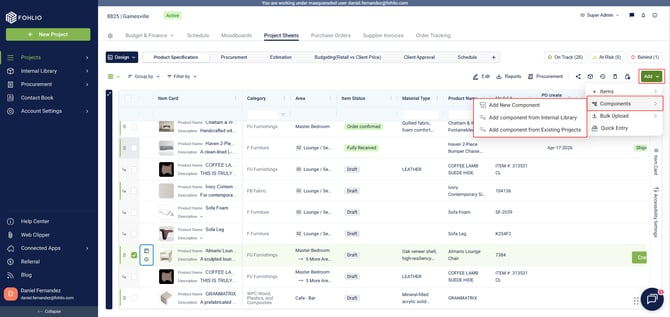
Add a Component from an Existing Project or Internal Library.
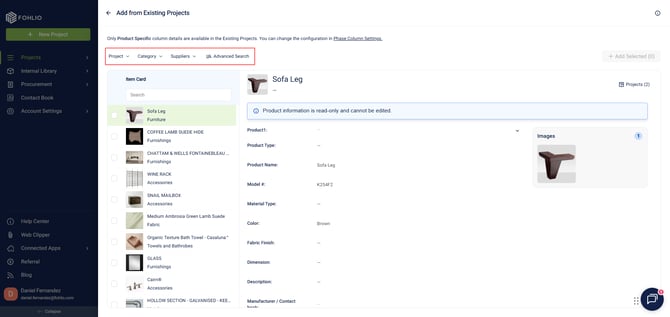
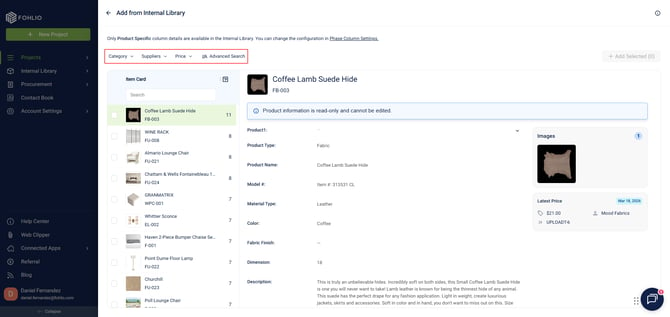
The process of addin a component from the Internal Library and existing projects is pretty much the same. The only different is the source from where you bring the component info. These options are useful when the component already exists in another project or in the Internal Library.
- Select the parent item.
- Click Add.
- Hover over Components.
- Select Add from Existing Project or Add from Internal Library.
- Confirm the component behavior message.
- Search or filter for the item you want to use as a component.
- Select it.
- Click Add Selected.
You can filter by:
- Project
- Category
- Supplier
- Advanced Search
Advanced Search lets you filter using any available column and condition.
Adding a component from an exisiting project.
Adding a component from the Internal Library.
Note: Each component is added as an independent duplicate for each parent item. For example, if the same fabric is added to two different sofas, Fohlio creates one fabric component for the first sofa and a separate duplicate for the second sofa. They may share the same specifications, but they behave as separate component records.
Preview Component Details Before Adding
Before selecting a component, you can click the item to preview its information.
This may include:
- Product name
- Model number
- Color
- Dimensions
- Description
- Other specification details
You can also hover over the Projects card to see where that item is already being used.
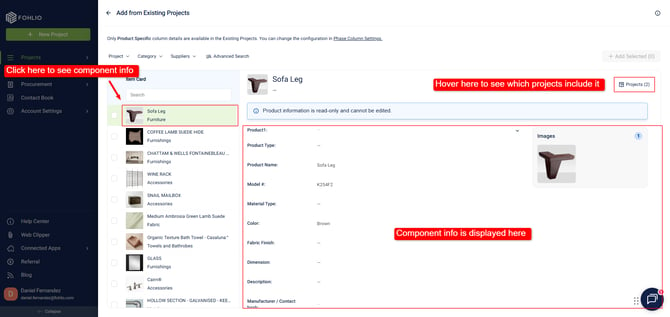
Manually Add a Component
Use this option when the component does not already exist in another project or in the Internal Library.
- Select the parent item.
- Click Add.
- Hover over Components.
- Select Add New Component.
- Choose the category that best matches the component.
- Click Confirm.
- Start entering the component information, such as product name, image, and others.
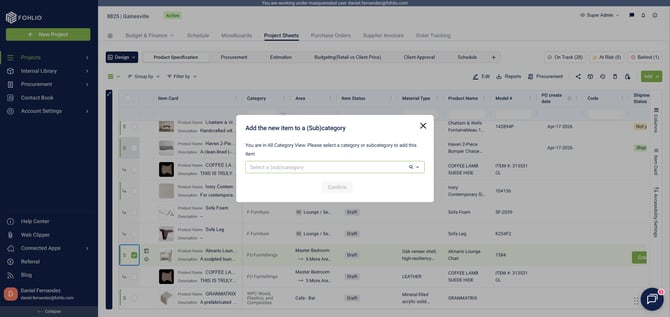
For example, if you are adding foam to a sofa, select the closest matching category and then enter the component details.
How Components Appear in the Project
Components always stay connected to their parent item.
In the project view:
- The parent item appears in a darker gray row.
- The component appears below it in a lighter gray row.
- Components move with the parent item when it is reordered.
- A component indicator appears next to the component row.
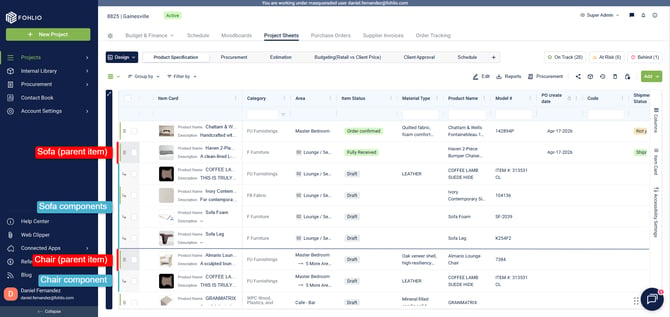
This helps users clearly see which components belong to each parent item.
Add the Same Component to Multiple Parent Items
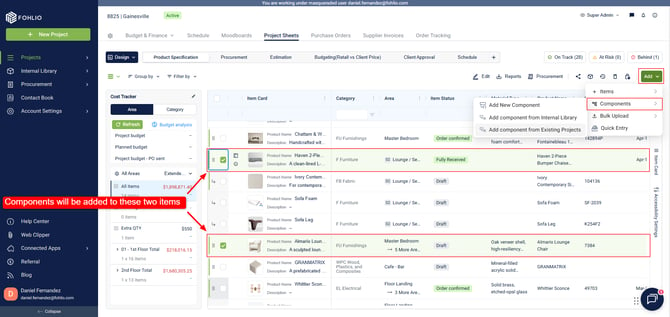
You can add the same component to multiple parent items at once.
- Select multiple parent items.
- Click Add.
- Hover over Components.
- Choose the source.
- Select the component.
- Click Add Selected.
Fohlio will create an independent duplicate of the component for each selected parent item.
For example, if you add the same fabric to a sofa and a chair, each item will receive its own fabric component. The specifications may match, but the components behave as separate records.
How Components Show in the Advanced Data Sheet Report
Components can also appear in the Advanced Data Sheet Report.
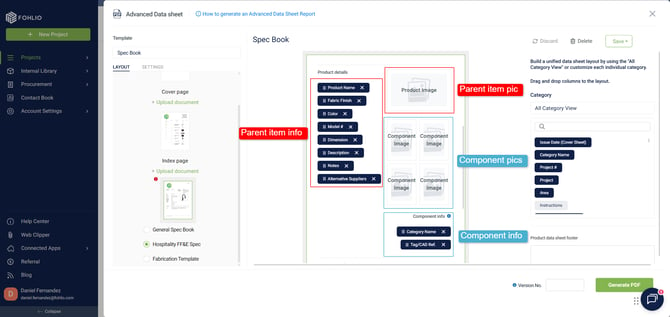
When configuring the report content page, you can choose fields for:
- Product Details — information from the parent item
- Component Info — information from the component
For example, the parent item section may show the chair name and main product image, while the component section may show the fabric name, image, category, code, or tag.
You can also include component images in the report.
Pro tip 💡: For a full walkthrough of how to configure this report, click here visit the Advanced Data Sheet Report article.
How Component Pricing Works
Components can also be used in pricing calculations.
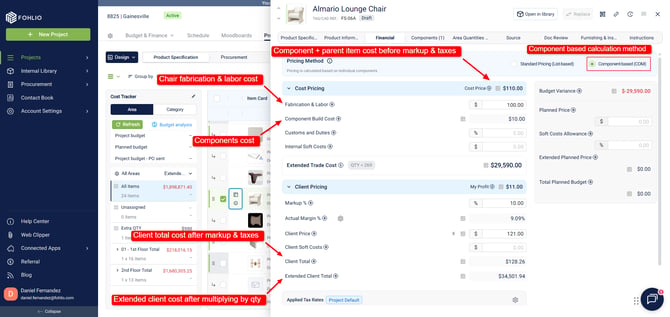
When using component-based pricing, Fohlio can add component costs to the parent item’s pricing calculation. This is useful for custom fabrication workflows where the main item has a base fabrication price and the components add their own costs.
Note: To add component costs, including taxes, to the parent item’s pricing calculations the Component-based (COM) pricing method needs to be selected.
For example:
- Parent item: Custom chair
- Base fabrication price for the chair: $100
- Component: Fabric
- Fabric cost: $10
In this case, the component cost is added to the parent item’s pricing calculation, helping you understand the full cost structure of the custom item.
Main item financials (including components price).
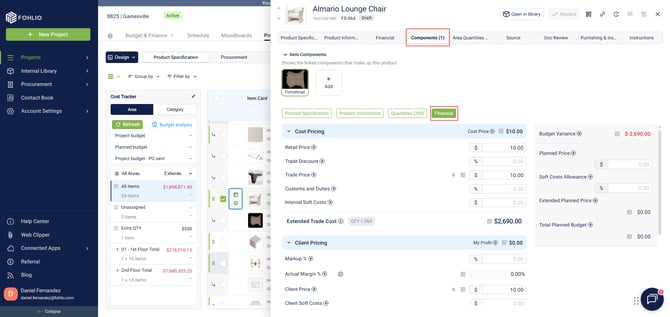
Component finantials.
To deep more into Advanced Financial click here.
Wrap-Up
Components help you manage detailed product relationships in Fohlio.
Use them when you need to:
- Track smaller parts of a main item
- Manage separate specifications or images
- Add component pricing to parent item calculations
- Display component information in reports
- Keep related items connected in your project
We hope this article was helpful, please reach us via Live Help if you still need assistance.